
Ask a Grade 8 learner who she is, and she will tell you what she wears, what she watches, and who she sits with at break. Ask again, and she will run out of answers somewhere around the second sentence. This is not her failure. It is ours.
We have built an entire schooling system that rewards the visible surface of a young person, her marks, her behaviour, her uniform, her reactions, and almost no scaffolding at all for the bulb underneath. We mark the onion’s skin. We do not even acknowledge the layers.
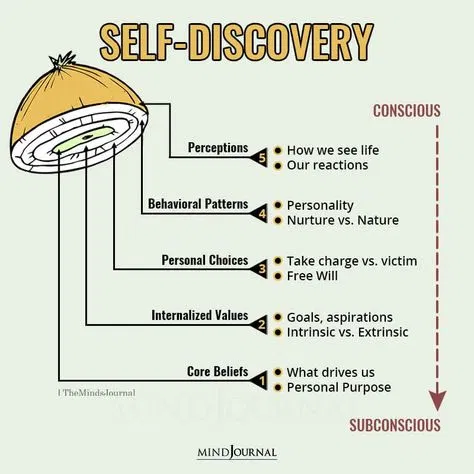
The image above, doing the rounds on social media courtesy of The Minds Journal, which landed in my inbox this morning, makes the problem hard to look away from. An onion. Five layers. Perceptions at the top, where the light gets in. Core beliefs at the bottom, in the dark. And a red arrow running down the right-hand side from conscious to subconscious, telling you exactly which direction the real work travels.
Most schools, most homes, most well-meaning interventions work on layer five. Adjust your reactions. Watch your attitude. Change how you see things. We treat young people like onions; we can sort by the skin. But the skin is the last thing to form on an onion, and the first thing to slip off. The bulb grows from the inside out.
At Rudder4Life (R4L), this is the territory we have been focused on for years. The Rudder4Success Framework is built on the same logic as the onion diagram, just with the navigation language of a boat rather than a vegetable. Different metaphor, same insight. You cannot steer a life from the top layer down. You have to start at the keel.
What the Onion Is Really Saying
Read the diagram from the bottom up, and the architecture becomes clear.
- Core beliefs sit underneath everything. What drives us. Personal purpose. These are the deepest convictions a young person holds about herself and the world, often laid down before she had words for them. A Grade 8 learner who believes, somewhere in the basement of her mind, I am not the kind of girl who finishes things, will struggle to finish things, no matter how many study schedules you draw up for her.
- Internalised values form the next layer. Goals, aspirations, intrinsic vs extrinsic. Values are the bridge between belief and choice. They are the standards by which a young person decides what counts as worth doing.
- Personal choices come next. Take charge vs victim. Free will. The pivot point. The place where the inner life starts meeting the outer one.
- Behavioural patterns are layer four. Personality. Nurture vs nature. The habits, the defaults, the way you tend to show up across many small Tuesdays.
- Perceptions are layer five. How we see life. Our reactions. The visible bit. The bit a teacher sees, a parent sees, a peer sees. The skin of the onion.
The diagram’s quiet provocation is that anyone trying to change a young person at layer five, without doing the work at layers one and two, is essentially rearranging deckchairs. The chairs will move. The ship will not.
Where the Rudder4Success Framework Comes In
The four Rudders of our framework were deliberately designed to enter the bulb from the bottom and work upward. Here is how they correspond to the layers:
- Rudder 1, Knowing Myself, is the dive into core beliefs and self-concept. Who am I, really, beneath the labels other people have stuck on me? This is where a learner is invited to examine the unexamined, the inherited stories, the assumptions she has been carrying around like an old school bag. It is uncomfortable work. It is also, without exception, the most important work a fourteen-year-old can do, because everything else she will build sits on it. The onion’s layer one. The keel of the boat.
- Rudder 2, Guiding Myself, takes on internalised values and self-motivation. What do I actually believe is worth pursuing? Whose voice is that in my head, telling me what success looks like? This is the layer where a young person begins to distinguish between values she has chosen and those she has merely absorbed, like a fish absorbing the water’s temperature. The onion’s layer two.
- Rudder 3, Expressing Myself, lives at the intersection of personal choice and behavioural patterns. This is where free will gets practised, not theorised. What do I do with what I now know about myself? It is the layer where the inner work begins to produce outer evidence, where a learner moves from a victim posture to an author posture in her own story. The onion’s layers three and four.
- Rudder 4, Achieving Success, surfaces at the top, in the realm of perceptions and reactions, but with one critical difference. The young person who arrives here has built upward, not downward. Her achievements are not a costume she puts on to please adults. They are an expression of the keel beneath. The onion has five layers, but it is rooted.
Why This Sequence Matters in South Africa, Right Now
In a context like ours, the temptation to skip layers is enormous. We are an anxious society raising anxious teenagers in an anxious economy, and the loudest interventions tend to chase the top of the onion. Improve your matric marks. Adjust your behaviour. Mind your reactions. These are not bad things to ask of a young person. They are just impossible things to ask of a young person whose layer one is rattling around unattended.
I think of it like trying to insulate a house in Khayelitsha against the southeaster by painting the outside walls a warmer colour. The wind does not care about your paint. The wind cares about your bricks.
A Grade 8 learner transitioning from primary to high school is undergoing the most consequential bulb-formation of her young life. The values she sets down now, the beliefs she lets settle, the self-concept she allows to take root, these become the layers everything else grows out of. Miss this window, and you won’t catch her up later. You are reaching her after the onion has formed and trying to insert a new layer through the skin. It does not work. It has never worked. It is why so many adult-development programmes feel like they are pushing a rope.
The Conscious-Subconscious Arrow
Look again at that red arrow on the right of the diagram. Conscious at the top. Subconscious at the bottom. The deeper you go, the less the young person is even aware of what is shaping her.
This is the part most curricula refuse to touch. It feels too soft, too therapeutic, too far from the syllabus. But here is the awkward truth: the subconscious does not stop running the show just because the timetable does not have a slot for it. A learner whose subconscious whispers, “You are not the kind of person who belongs here” will hear that whisper through every algebra lesson, every Life Orientation period, every sports trial.
R4L’s work, in essence, is to bring a torch into that basement. Not to fix what is down there. To let the young person see what is down there, name it, examine it, and decide what stays.
That is what self-discovery actually is. Not a personality quiz. Not a strengths assessment. A descent, with support, into the layers most people spend their whole lives avoiding.
What This Means for Parents, Teachers and Funders
If you take the onion seriously, three things follow.
- Behaviour management without belief examination is mostly theatre. You can suspend a child for the behaviour. However, unless you reach the belief that produced it, the behaviour will reappear in a new guise. This is precisely why our Learning Facilitation Centre (LFC), the R4L LFC, exists as it does. The LFC is not a detention room with a softer name. It is a restorative space where a learner is helped to surface the belief sitting underneath the behaviour, examine it, and decide whether she wants to keep carrying it. The discipline is not the point. The descent is the point.
- The early high-school years are not too early for this work. They are exactly the right time. The layers are still soft. They harden quickly. This is why the R4L Youth Development Programme runs for thirty-two weeks across the Grade 8 year, not a once-off workshop, not a holiday camp, not a motivational assembly. The bulb forms slowly. So does the work.
- Programmes that work at the bottom of the onion look slower than programmes that work at the top. They are not slower. They are deeper. And without the right instruments, the depth is invisible to the people funding the work. This is what Pulse4Success was built for. Our digital tracking platform allows us to follow what is happening underneath the waterline, the shifts in self-concept, the changes in decision patterns, the quiet evidence that the keel is taking shape, long before those shifts surface in marks or behaviour reports. You cannot manage what you cannot see. Pulse4Success makes the invisible visible, week by week, learner by learner.
Compound interest shows up in Grade 11, in their first job, in their first hard relationship, in the first time life serves up something the young person did not plan for. We have made our peace with looking slow. The keel takes time to lay. But a boat without one does not sail. It drifts. And there is no shortage of young people drifting through our schools right now, perceptions intact, core beliefs unattended, wondering why the wind keeps pushing them in directions they did not choose.
Peel back the layers. Start at the bottom. That is where the work is.
#Rudder4Life #R4L #SEL #Grade8 #WholeChild #YouthDevelopment #EducationSA #CapeTown